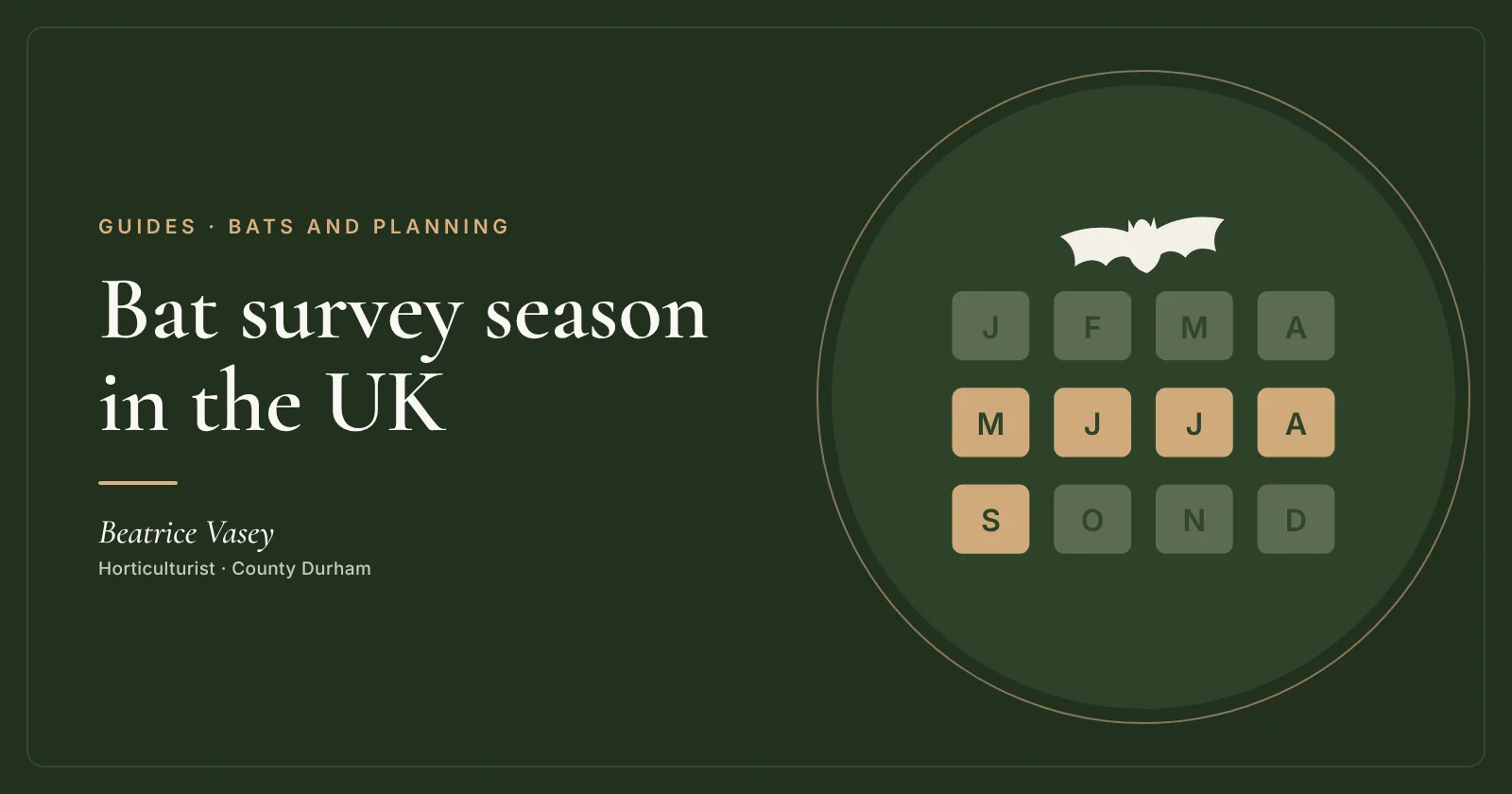
The bat survey season in the UK is not one fixed window. A preliminary roost assessment can be done in any month, but the dusk emergence surveys that confirm whether bats roost in a building only run from May to September, and hibernation surveys only run in winter. Which survey you need, and when your ecologist rates the building, decides how long your planning application waits. The dates below come from the Bat Conservation Trust's Bat Surveys for Professional Ecologists: Good Practice Guidelines (4th edition, 2023), the standard UK ecologists and councils work to, and from GOV.UK's planning guidance.
The bat survey season at a glance: month by month
Most ecology survey calendars show bats across several rows because each type of bat survey has its own window. Bats are not the only protected species with fixed survey timing: GOV.UK gives mid-March to mid-June for great crested newts, for example, which is why larger sites usually start with a preliminary ecological appraisal that lists every survey needed. This is the bat part of the calendar for a typical planning application.
| Month | Bat surveys that can be carried out |
|---|---|
| January | Preliminary roost assessment (PRA); hibernation surveys, in the peak period |
| February | PRA; hibernation surveys, in the peak period |
| March | PRA; hibernation surveys, as hibernation ends |
| April | PRA; bat activity surveys start, weather and location permitting. No presence/absence emergence surveys yet |
| May | PRA; emergence survey season opens; activity surveys. After a cold spring, surveys should not start in early May |
| June | PRA; emergence surveys (optimal); activity surveys |
| July | PRA; emergence surveys (optimal); activity surveys |
| August | PRA; emergence surveys (last month of the May to August window); activity surveys; swarming surveys begin |
| September | PRA; emergence surveys, weather and location permitting; activity surveys; swarming surveys |
| October | PRA; activity and swarming surveys, weather permitting. The emergence survey season has closed |
| November | PRA; hibernation surveys begin |
| December | PRA; hibernation surveys |
The short version: the PRA is the only bat survey you can book in any month. Everything that needs bats to be out and flying sits between April and October, and the presence/absence emergence surveys that planners most often ask for sit between May and September.
When can bat surveys be carried out? Survey by survey
Preliminary roost assessment: any time of year
A PRA is a daytime inspection of a building or tree for bats, droppings and the gaps and crevices bats roost in. The BCT guidelines say PRAs can be carried out at any time of year, and in any weather as long as it is safe, provided any limitations are recorded in the report. GOV.UK adds that trees are best surveyed without foliage, so winter suits a tree assessment. The PRA ends with a roost suitability rating (negligible, low, moderate or high) that sets how many further surveys you need.
Bat emergence survey season: May to September
Emergence surveys watch a building from dusk with bat detectors and night vision aids to see whether roosting bats leave it, and so whether a bat roost is present. The BCT survey guidelines define the survey period for these presence/absence surveys as May to September, with at least some visits between May and August, when maternity colonies are present. September visits are weather and location dependent: they are likely to miss maternity roosts, which disperse before then, but may pick up mating roosts.
Dawn re-entry surveys, which watch bats returning at first light, used to be paired with dusk visits. The 4th edition says return times vary so much that re-entry surveys are no longer recommended as a standard approach, so most sequences are now dusk surveys only.
Bat activity surveys: April to October
On larger or greenfield sites, ecologists walk transects at night and leave static detectors out to record how bats feed and commute across the land. GOV.UK gives April to October for these. The BCT guidelines ask for one walked survey per season (spring in April or May, summer in June to August, autumn in September or October) and static detectors for at least five consecutive nights per season, or per month on better habitat. April and October visits depend on the weather, particularly in northern England and Scotland.
Hibernation surveys: November to March
Hibernation surveys check cool, stable places such as cellars, tunnels and ice houses for hibernating bats. The BCT guidelines treat November to March as the hibernation period, with peak numbers usually in January and February. Because the visits can disturb sleeping bats, they are kept to a minimum: where numbers need counting, the guidelines recommend two visits four weeks apart in the coldest months. They only apply where the PRA found a structure suitable for hibernating bats, so most house and loft projects never need one.
Swarming surveys: August to October
Swarming is when large numbers of bats gather at caves, mines and other underground sites in late summer and autumn. GOV.UK gives August to October for swarming surveys. They are a specialist survey for sites near underground features, not something a typical planning application needs.
How many bat surveys you need, and how far apart
The number of dusk visits comes from the PRA's suitability rating. These are the BCT minimums to give confidence that a building has no bat roost:
| Roost suitability | Minimum emergence surveys | When they must fall |
|---|---|---|
| Negligible | None | No further survey |
| Low | One dusk survey | May to August |
| Moderate | Two separate dusk surveys | May to September, at least one in May to August |
| High | Three separate dusk surveys | May to September, at least two in May to August |
Visits should be spaced at least three weeks apart, and preferably more, to sample as much of the season as possible. That means a three-visit sequence spans at least six weeks from first survey to last. Your ecologist can adjust the number of visits up or down for your site, but has to justify it in the report. Each visit is charged separately, so the rating shapes both your timetable and what each survey costs (see what each survey costs).
Weather, temperature and the northern season
Bats fly less in cold, wet or windy weather, so a survey on the wrong night can miss them. The guidelines set clear expectations:
| Temperature | Aim for a sunset temperature of 10°C or above. If it drops well below that during the survey, the ecologist may stop it. |
|---|---|
| Rain and wind | Avoid heavy rain and strong wind. |
| Timing on the night | Dusk surveys start 15 minutes before sunset and run for 1.5 to 2 hours after it. |
| Cold springs | In a year with a cold spring, surveys should not start in early May or all be done in May. |
| Records | Temperature, wind and rain are recorded at the start and end of every survey. |
Latitude matters too. The BCT guidelines note the bat active season is likely to be shorter further north, that September surveys are less suitable in more northerly latitudes, and that April and October activity surveys are especially weather dependent in northern England and Scotland. In Scotland, October emergence surveys are not acceptable at all. For a site in the North East, plan on the core months of May to August doing most of the work, and treat September as a bonus rather than a fallback.
Why the bat survey season matters for your planning timeline
All UK bats are European protected species. In England and Wales they and their roosts are protected under the Conservation of Habitats and Species Regulations 2017 and the Wildlife and Countryside Act 1981. Natural England's standing advice on bats is a material planning consideration for local planning authorities, and GOV.UK tells them not to decide a planning application until they have every survey they need. They should not usually grant planning permission with a condition asking for surveys later, and they can refuse an application if the surveys were carried out at the wrong time of year or are out of date.
So the season is not a formality. If the PRA finds roosting potential, the further survey work has to be done and written up before your application can be decided. The BCT guidelines also say survey data should ideally come from the most recent optimal survey season before a planning or licence application goes in, which is why a report from several years ago may need updating.
What happens if you miss the bat survey season
The most common way to miss it is a PRA in late summer or autumn that rates the building moderate or high. A few worked examples, using the BCT minimums:
- PRA in early August, moderate rating. One visit in mid-August and a second three or more weeks later in September can still meet the guidelines, weather permitting.
- PRA in late August, high rating. Two of the three visits must fall between May and August, so only a September visit is possible this year. The rest waits for next May.
- PRA in October or later, any rating above negligible. No emergence surveys until May, then the visits themselves take between three weeks and two months or more to complete.
In England there is one possible route around a delay. Natural England's licensing policy 4 can accept less than the standard survey effort when the cost or delay of a full survey would be disproportionate, the impact on bats can be predicted with enough confidence, and the mitigation covers the worst plausible case. Its own example is bats found near the end of the survey season, where only part of the standard surveys can be done. It is a licensing policy your ecologist has to justify, and the trade-off is usually more compensation, so treat it as an exception rather than a plan.
If bats are present: bat mitigation and a bat licence
If the surveys show bats are present, your ecologist designs the bat mitigation and, once planning permission is granted, applies for a bat licence from Natural England (NatureScot in Scotland, Natural Resources Wales in Wales). Building work that affects the roost then has to fit around the bats as well as the licence.
Book your survey before the season closes: a planning timeline
If you think you need a bat survey, the best time to commission the PRA is the winter or early spring before you submit. A PRA done between November and March leaves time to book your survey before the season closes, so any dusk surveys it recommends can start in May and the whole sequence fits inside one season and your build programme.
| When | What to do |
|---|---|
| November to March | Commission the PRA. Ask your ecologist to pencil in emergence survey dates if the building looks suitable |
| April | Confirm survey dates and access, and check whether your project also needs activity surveys |
| May to August | Emergence surveys, at least three weeks apart; at least one or two of them in this window |
| September | Final visit for moderate or high suitability buildings if needed, weather permitting |
| Autumn | Survey report with mitigation submitted with your planning application |