A protected species in the UK is a wild animal, plant or fungus that the law shields from being killed, injured, taken or disturbed, and in many cases protects the places it breeds and shelters too. Several pieces of wildlife legislation overlap, so the protection a species gets depends on which law and which schedule it sits in. For anyone planning building work, the practical questions are simpler: which species could be on the site, what exactly is an offence, when can an ecologist survey for them, and when is a licence needed. This guide answers those questions for England, with notes on Scotland and Wales, using the legislation itself and Natural England's standing advice to councils.
What makes a species protected in the UK
Protection comes from statute, not from how rare an animal looks. A species is protected because it is listed in a schedule of an Act or regulation, and the wording of that listing sets what you must not do. Some species are protected against almost everything: killing, injury, capture, disturbance and damage to their habitat. Others are protected only against sale, or against deliberate killing and injury. The offences also turn on intent. The Conservation of Habitats and Species Regulations 2017 use "deliberately" for most offences, but damaging or destroying a breeding site or resting place is an offence without any need to show intent. The Wildlife and Countryside Act 1981 uses "intentionally" and, for shelters and disturbance, "intentionally or recklessly".
Protected species law runs alongside the planning system rather than inside it. GOV.UK's advice to local planning authorities says protected species licences are separate from planning permission and follow their own legal tests, so planning consent never authorises harm to a protected animal on its own. Protected species and habitats are also handled separately in law: a Site of Special Scientific Interest (SSSI) or a special area of conservation protects a place, while species protection follows the animal or plant wherever it lives, including an ordinary back garden or a derelict barn.
The main UK wildlife legislation for protected species
Four laws do most of the work in England. Each protects a different set of species in a different way.
| Law | Which species | Main offences |
|---|---|---|
| Conservation of Habitats and Species Regulations 2017 | European protected species: the animals in Schedule 2 and the plants in Schedule 5 | Deliberately capturing, injuring, killing or disturbing the animals; damaging or destroying a breeding site or resting place; picking or destroying the plants |
| Wildlife and Countryside Act 1981 | All wild birds (section 1), animals in Schedule 5 (section 9), plants, fungi and lichens in Schedule 8 (section 13) | Killing or taking birds and their eggs; damaging a nest in use or being built; harming Schedule 5 animals or their shelters, as each listing allows; picking or uprooting Schedule 8 plants |
| Protection of Badgers Act 1992 | Badgers and their setts | Killing, injuring or taking a badger; interfering with a sett by damaging, destroying or blocking it, or disturbing a badger occupying it |
| Natural Environment and Rural Communities Act 2006, section 41 | Species and habitats of principal importance for conserving biodiversity in England | No offences: the list of species and habitats tells public authorities what to consider for nature conservation when making decisions |
European protected species
European protected species get the strongest protection. The name comes from the EU Habitats Directive, whose Annex IV species the 2017 Regulations still refer to. Schedule 2 of the Regulations lists the animals: all horseshoe and typical bats, the great crested newt, otter, hazel dormouse, sand lizard, smooth snake, natterjack toad, pool frog, Eurasian beaver, wildcat, all dolphins, porpoises and whales, sturgeon, marine turtles, the large blue butterfly, Fisher's estuarine moth and the lesser whirlpool ram's-horn snail. Schedule 5 adds nine plants, among them lady's-slipper orchid, fen orchid, creeping marshwort and yellow marsh saxifrage.
For these species it is an offence to damage or destroy a breeding site or resting place even when the animals are not there. Disturbance is defined widely: anything likely to impair their ability to survive, breed, rear young, hibernate or migrate, or to significantly affect their local distribution or abundance.
What the Wildlife and Countryside Act 1981 covers
The 1981 Act is older and broader. It protects every wild bird, its eggs and its active nest, gives extra protection against disturbance to the rare birds on Schedule 1, and lists other animals on Schedule 5 with protection tailored to each. Water voles and red squirrels are protected against killing, taking and harm to their shelters, for example, while adders, grass snakes, common lizards and slow-worms are protected only against killing, injury and sale. If you need the detail of each schedule, there is a separate guide on what the 1981 Act covers.
England, Scotland and Wales
The 2017 Regulations extend to England and Wales, and to Scotland only for reserved matters. Scotland has its own habitats regulations and its own amendments to the 1981 Act, including higher penalties. Licences come from Natural England in England, NatureScot in Scotland and Natural Resources Wales in Wales, and the survey guidance each body publishes differs in places.
Protected species list UK: what animals are protected on development sites
This protected species list covers the UK species an ecologist most often deals with on building sites and in planning applications. Natural England publishes standing advice for councils on each of them, which is where the survey triggers below come from.
| Species | Main law | What's protected | When it's surveyed |
|---|---|---|---|
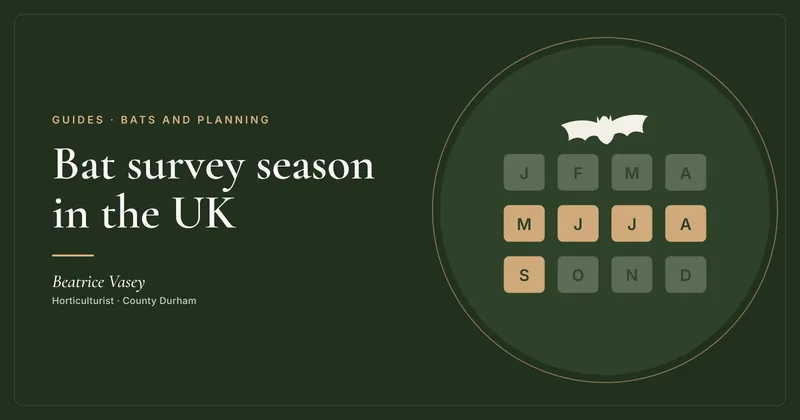
| Bats (all 18 UK species) | 2017 Regulations; 1981 Act | The bats and their roosts, including roosts with no bats present | Roost assessment any time; emergence surveys May to September; hibernation surveys November to March |
| Great crested newt | 2017 Regulations; 1981 Act | Newts, their ponds and the land habitat they shelter in | Spring; eDNA pond sampling 15 April to 30 June |
| Badger | Protection of Badgers Act 1992 | Badgers and their setts | Any time of year; February to April is best |
| Otter | 2017 Regulations; 1981 Act | Otters, holts and resting places | Any time of year, avoiding the days after heavy rain |
| Water vole | 1981 Act | Water voles and their burrows | Mid-April to September, while they are active |
| Hazel dormouse | 2017 Regulations; 1981 Act | Dormice and their nests in woodland, hedgerow and scrub | The active season, using nest tubes, nest boxes or footprint tunnels |
| Wild birds | 1981 Act | Birds, eggs and any nest in use or being built | Before any clearance in the nesting season |
| Reptiles | 1981 Act (sand lizard and smooth snake also 2017 Regulations) | Common lizard, slow-worm, grass snake, adder: killing and injury. Sand lizard and smooth snake: full protection | April to September; April, May and September are best |
| White-clawed crayfish | 1981 Act | Taking, possessing and selling the crayfish | July to September |
| Protected plants, fungi and lichens | 1981 Act Schedule 8; 2017 Regulations Schedule 5 | Picking, uprooting or destroying the listed species | When the species can be identified, which varies by plant |
The bat survey windows match the Bat Conservation Trust's guidelines; the others come from Natural England's standing advice, Natural Resources Wales's newt eDNA window and NatureScot's species planning advice. Your ecologist sets the exact timing for your site.
Bats and planning: why roosts are protected even when empty
The Bat Conservation Trust records 18 bat species in the UK, 17 of them known to breed here, and every one is a European protected species. Natural England's standing advice says breeding sites and resting places are protected "including when bats are not present", so a loft or a tree used only in summer is still a protected roost in winter. Councils are told to ask for a survey where a proposal is likely to affect bats: buildings with loose tiles, gaps or hanging tiles, trees with cavities or loose bark, new lighting near bat habitat, and work near water or woodland. Bats are the species most likely to hold up a householder project, so there is a full guide to the rules on bats and planning, from the roost assessment to the licence.
Other protected species and what the law protects
Great crested newts
Great crested newts are a European protected species, and the protection covers their land habitat as well as their ponds. Natural England's advice says councils should ask for a survey where a suitable pond or ditch lies within 500 metres of the development, even one that only holds water for part of the year, though surveys of water bodies within 250 metres are usually sufficient. Survey data should be no older than four survey seasons. In areas with a district level licensing scheme, developers can pay into a compensation fund for new ponds instead of carrying out detailed surveys and applying for their own licence.
Badgers and their setts
Badgers are not rare, but the Protection of Badgers Act 1992 makes it an offence to damage, destroy or block a sett, to send a dog into one, or to disturb a badger occupying it, whether you intend to or are reckless about the result. Natural England expects a survey wherever records show badgers are active or the site has habitat suitable for setts or foraging, and its advice says mitigation should not include moving badgers off the site.
Nesting birds
Every wild bird is protected, and it is an offence to take, damage or destroy a nest while it is in use or being built. Unlike bats or newts, there is no licence that allows development to destroy an active nest: GOV.UK states plainly that Natural England cannot issue a wild bird licence to allow development. Clearance of trees, hedgerows and scrub is therefore timed outside the nesting season, or preceded by a check for nests. Birds on Schedule 1, such as the barn owl, are also protected from disturbance near the nest.
Otters and water voles
Otters are a European protected species; their holts and resting places are protected even when empty. Water voles are protected under the 1981 Act, and Natural England notes they are listed as endangered on the Mammal Society's Red List. Both are surveyed along rivers, streams, ditches and ponds, and any proposal that affects a watercourse or its banks should expect the question.
Hazel dormice
Dormice are a European protected species listed as vulnerable on the Mammal Society's Red List. Surveys are needed where a proposal affects woodland, hedgerow or scrub and records suggest dormice could be present; for small jobs such as a short hedgerow gap, a search for nests and gnawed hazelnuts can be enough.
Reptiles
The four widespread reptiles (common lizard, slow-worm, grass snake and adder) are protected against intentional killing and injury. In practice that means a survey wherever a site has rough grassland, scrub or other suitable habitat, followed by staged vegetation cutting in the active season. Sand lizards and smooth snakes are European protected species and need a licence.
White-clawed crayfish
The white-clawed crayfish is protected under the 1981 Act and is a species of principal importance. Natural England's advice puts surveys in July to September and lists the threats development can bring: spreading disease through poor biosecurity and introducing non-native crayfish by connecting watercourses.
Protected plants
It is an offence to intentionally pick, uproot or destroy any plant, fungus or lichen on Schedule 8 of the 1981 Act, and for the nine European protected plants a mitigation licence is required for any of those actions. Any wild plant is also protected from being uprooted by someone who isn't the landowner or otherwise authorised.
When a protected species survey is needed
GOV.UK tells councils to ask the developer for a survey when there is suitable habitat on the site, when protected species are likely to be present and affected, or when they are present but the effect is unclear. Councils should not decide an application until all the surveys they need have been received, and they should check the ecologist is suitably qualified, licensed where the species requires it, and surveying at the right time of year. Most sites start with a preliminary ecological appraisal, which identifies the species worth surveying for; each protected species survey then has to fall in that species' season.
A lack of records is not proof of absence. Natural England's advice for bats, otters, reptiles, water voles, dormice and crayfish makes the same point, which is why councils ask for a survey on suitable habitat even where no sighting has been reported. The same GOV.UK page points councils to separate standing advice for ancient woodland, ancient trees and veteran trees, which deal with habitats rather than species.
Protected species in County Durham and the North East
Durham County Council's validation checklist sets out when an application must include a protected species survey and report. These are its main protected species triggers:
| Bats | A risk assessment for buildings with roost features within 200 metres of woodland or water, structures such as bridges, kilns and cellars, and trees with roost potential. Floodlighting within 50 metres of woodland, water or hedgerows needs a survey. |
|---|---|
| Great crested newts | A risk assessment for all applications within 250 metres of ponds and other standing water. |
| Barn owls | A survey for agricultural buildings such as barns and outbuildings, except single-skin livestock barns. |
| Survey age | Survey work must be no more than two years old when the application is submitted. |
Ground-floor householder work that doesn't touch the roof is exempt from the bat requirement. Two other species matter locally. Durham, Northumberland and Tees Valley Wildlife Trusts ran the Naturally Native project from 2021 to 2023 to stop the decline of water voles across the Tyne, Wear and Tees catchments; the Trusts say water voles have disappeared from over 95% of their former range and that the North East's lowland population is at risk of being lost. The Environment Agency has said populations of white-clawed crayfish remain in North East rivers, and trapping crayfish is banned in the region to protect them from the disease carried by invasive American signal crayfish.
Protected species licences from Natural England
If harm to a protected species can't be avoided, the work needs a licence before it starts. Natural England issues four kinds:
| General licence | For low-risk activities. There is no application; you follow the licence's conditions. |
|---|---|
| Class licence | For work needing specific skill, such as the bat mitigation class licence. The ecologist registers with Natural England, which can take up to 30 days. |
| Individual licence | For anything the general and class licences don't cover, including most development mitigation licences. It usually takes 30 working days. |
| Organisational licence | For organisations whose routine work affects protected species. |
For European protected species, the 2017 Regulations set three tests. The work must be for a listed purpose, such as imperative reasons of overriding public interest, including those of a social or economic nature; there must be no satisfactory alternative; and the licence must not be detrimental to keeping the species' population at a favourable conservation status. The Protection of Badgers Act allows licences for development on similar terms. Mitigation licences are available for European protected species, badgers and water voles, and an ecologist registered under class licence CL31 can displace water voles where a project affects less than 50 metres of bank.
Natural England will not generally issue a licence until the planning conditions relating to protected species have been discharged, so the usual order is survey, planning permission, then licence, then work. Bats also have a Bat Earned Recognition route for accredited ecologists, and great crested newts have district level licensing in some council areas.
Penalties for harming protected species
| Offence | Maximum penalty (England) |
|---|---|
| Bats, great crested newts and other European protected species | Up to six months in prison, an unlimited fine, or both |
| Badgers and their setts | Up to six months in prison and an unlimited fine |
| Wild birds, nests and eggs | Up to six months in prison and an unlimited fine for each offence |
| More than one animal, nest or plant | Under the 1981 Act and the Badgers Act, the fine is calculated as if each animal were a separate offence |
When sentencing for damage to a breeding site or resting place of a European protected species, the court must consider whether the person could reasonably have avoided it. A survey before work starts is the simplest way to show you did.
What to do if protected species could be on your site
| Look at the site honestly | Old buildings, mature trees, hedgerows, ponds within 250 to 500 metres, watercourses and rough grassland are the usual triggers. |
|---|---|
| Check your council's validation list | It sets out when a protected species survey must go in with the application. |
| Book early | Most species surveys run in spring and summer, so a late start can push an application back a year. |
| Use a qualified, licensed ecologist | Councils check licences and survey age, and Natural England checks them again at licensing. |
| Stop if you find something | If you uncover a bat, a newt or an active nest during work, stop and take advice before carrying on. |