A long, narrow garden has one great asset that a small square plot lacks: distance. The problem is that most long gardens show all of that distance at once, as a strip of lawn running between two fences to a shed at the back. Good long garden ideas avoid that tunnel effect. The aim is to slow the eye down, so the garden reveals itself a section at a time and every part of its length gets used. Here is how I approach a long and thin plot as a horticulturist, starting with the light and the plants rather than the paving.
Read the light along a long plot first
In a long garden, sun and shade change from one end to the other, so the layout should follow the light. In the UK the sun sits due south at midday, which means:
- North-facing gardens (the back of the house faces north) lose the strip nearest the house to shadow, especially in winter when the sun is low. The far end is often the sunniest part of the plot.
- South-facing gardens get sun near the house, and the far end may be shaded by trees or buildings behind it.
- East and west-facing gardens get morning or evening sun, and the two long side fences matter most: the bed at the foot of the fence on the sunny side gets the light, while the bed along the opposite fence sits in its shadow for much of the day.
Spend a day noting where the sun falls in summer and again in winter. A spot with three to six hours of direct sun in summer counts as partial shade; less than that is shade. My guide to choosing plants for your conditions explains how to read soil and exposure too. Once you know where the sun sits, you know where the seating, the veg beds and the shade planting belong.
How to divide a long narrow garden into rooms
Dividing a long narrow garden into a series of outdoor rooms, usually two or three distinct zones, is the single most effective change you can make. Each zone gets its own job, such as a patio near the house, a lawn or planting area in the middle and a seating area or growing space at the back of the garden, and the dividers stop you seeing the whole garden in one glance. The dividers don't need to cross the whole width: a hedge, screen or border that reaches in from one side, leaving a gap for the path, works better than a solid wall with a door in it.
Hedges as living dividers
A clipped hedge is the classic garden divider, and it gives far more to wildlife than a fence panel. The RHS groups hedging plants by height, and the medium to large hedges below reach 90cm to 180cm or taller, which is right for hiding the next room. For a low divide that you can see over, use a small hedge of 30cm to 90cm.
| Hedge | Height group | Good for |
|---|---|---|
| Beech (Fagus sylvatica) | Medium to large | Formal hedges; it holds its brown leaves until spring, so it still screens in winter |
| Hornbeam (Carpinus betulus) | Medium to large | A native alternative to beech, better suited to cold situations, though it drops its leaves sooner |
| Yew (Taxus baccata) | Medium to large | A dense, formal evergreen that can be kept narrow by clipping; it can grow about 30cm a year in good conditions |
| Ilex crenata | Small | A low evergreen edge or knee-high divide |
| Lavender (Lavandula angustifolia) | Small | A low, scented divide in a sunny, free-draining spot |
| Berberis × stenophylla 'Corallina Compacta' | Small | A dense, spiny dwarf hedge that copes with dry shade |
Young bare-root whips of about 60cm establish faster than larger plants and cost far less, which matters when a long garden needs several plants per metre. Bare-root hedging goes in while the plants are dormant, usually from late October to March.
Screens, trellis and arches
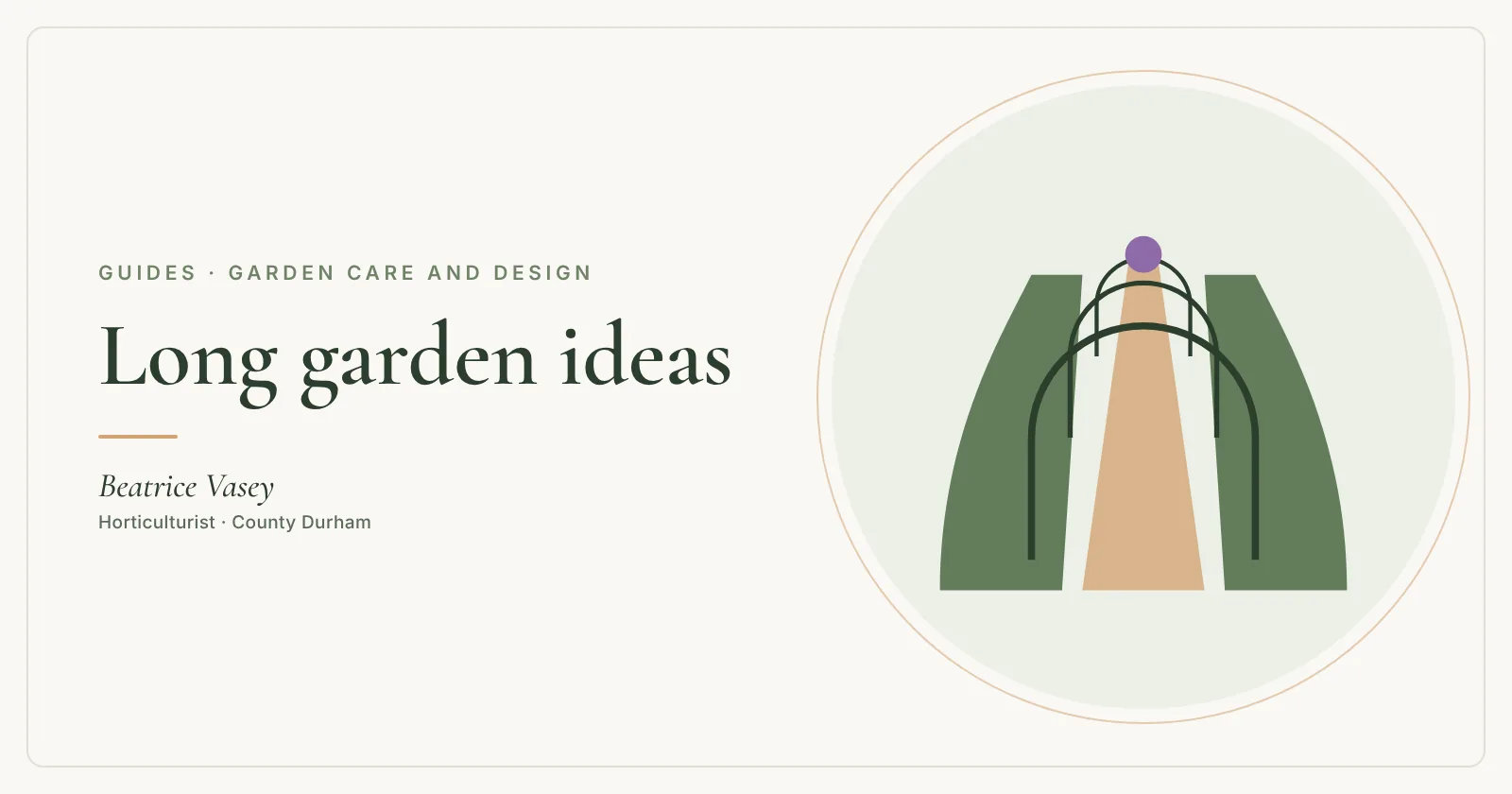
Where a hedge would take too much width, a trellis screen planted with climbing plants divides the space in a few centimetres. An arch over the path marks the doorway between rooms and frames the view through to the next one, and a pergola over a seating area does the same job while adding height and shade. Put the wires or trellis in place before planting, and set climbers about 45cm out from the base of a wall or fence, angled back towards it, so rain reaches the roots.
Obelisks and tall plants as soft dividers
Not every divide has to be solid. A pair of obelisks planted with clematis or sweet peas either side of the path, or a band of tall, see-through perennials and grasses across the garden, creates a veil rather than a wall. You glimpse the space beyond, which makes the garden feel larger rather than chopped up.
Diagonal, zigzag and curved layouts
The quickest way to stop a long garden feeling like a corridor is to break the straight line down its middle. Three layouts work well:
| Layout | How it works | Best for |
|---|---|---|
| Diagonal | Set the patio, lawn and beds on a 45-degree grid to the house, so the longest lines run corner to corner rather than end to end | Modern gardens and short-to-medium plots where the diagonal adds width |
| Zigzag | The path crosses from side to side between rooms, with planting filling the triangles it leaves | Very long, narrow gardens that need three or more rooms |
| Curves and circles | A series of round lawns or patios linked by a curved path, with deep planting beds in the corners | Planting-led and cottage gardens where you want the edges hidden |
Whichever you choose, the planting does the hiding. Each time the path turns, a shrub or tall perennial should block the view ahead, so you have a reason to walk on.
Paths that meander
Straight paths down one side of a narrow garden are practical, and they suit a garden with one deep border along the sunny fence. But a path that meanders in a gentle curve, rather than straight, makes a long garden feel wider and slower. Stepping stones set in gravel or lawn, natural stone near the house giving way to bark or grass further down, or a path that changes material from room to room, all help. Keep the main route wide enough to walk with a wheelbarrow, and let plants spill over the edges to soften the line.
Focal points that pull you down the garden
A long view needs something at the end of it. A focal point, such as a bench, a small tree, a water feature, a large pot or a piece of sculpture, will draw the eye, give it somewhere to land and invite you to walk towards it. In a garden divided into rooms, place a smaller focal point in each one, lined up with the gap in the divider, so the view through each doorway ends in something worth seeing. A good tree in a neighbour's garden or on the skyline can be borrowed in the same way: frame it with your own planting and it becomes part of the design.
Tricks to make a narrow garden feel wider
You can't move the boundary fences, but you can create the illusion of width and make the garden feel bigger.
| Lay paving across the plot | Lay paving slabs, deck boards or edging so their long lines run from side to side, not away from the house. |
|---|---|
| Hide the boundaries | Cover fences with climbers and wall shrubs, or a living wall in a sheltered spot, so the edges disappear into green. |
| Break up the strip of lawn | Let borders cut into the lawn from alternate sides, so the lawn becomes a series of wider shapes. |
| Use one deep border | One generous border along the sunny side, rather than two thin strips, gives plants room and makes the space feel less pinched. |
| Repeat plants | Repeating a few plants down the length of the garden ties the rooms together, so it reads as one generous garden rather than a collection of bits. |
| Go up | Vertical planting on fences, obelisks and arches adds growing space without taking width. |
Planting for depth in a long garden
Planting is what turns a long garden design from a layout into a place, and it matters more than any choice of materials. I think in layers: trees or tall shrubs for height and structure, then medium shrubs, then perennials and grasses, then ground cover to knit it together. In a narrow plot the layers work along the length as well as across it, with taller planting at each divide and lower planting in the middle of each room so it feels open.
Evergreens give the garden its bones in winter, when a long, bare plot looks at its longest. Deciduous shrubs and perennials bring the seasonal change. Plant perennials in September or March, and mulch with 5cm to 7cm of garden compost, keeping it clear of the crowns. If you would like the borders worked out for you, a planting plan for each room sets out what goes where, drawn to scale from your measurements.
For trees, choose upright forms that don't spread across the plot. The RHS suggests columnar trees for tight spaces because they "do not spread appreciably", and it recommends drawing a scale plan with the tree's mature size marked on it before you buy. Remember that a tree planted in a corner sends most of its shade into the neighbours' gardens.
Using the far end of a long garden
The far end is often the most wasted part of a long garden, and often the part with the most potential. Decide what it is for based on its light.
| Use | Suits | Ideas |
|---|---|---|
| Second seating area | A sunny far end, especially in a north-facing garden | A bench or small terrace that catches evening sun and gives a view back to the house |
| Vegetable and fruit growing | The sunniest, most sheltered part of the plot | Raised beds, a cold frame, compost bins and fruit trained on the fences |
| Wildlife area | Any end, sunny or shaded | Long grass, a log pile, a native hedge, and a pond if there is sun |
| Working area | A shaded or awkward end | The shed, water butts and compost, screened by a hedge or trellis |
For a wildlife area, the RHS advises siting a pond where it gets plenty of sun and won't quickly fill with fallen leaves, with at least one sloping side so frogs and other wildlife can get in and out. A log pile can be tucked behind the shed or at the back of a border, and letting the grass grow long through summer feeds the caterpillars of several butterflies. A 13cm by 13cm hole at the base of the fence lets hedgehogs pass between gardens, and a long row of terraced gardens linked this way becomes a proper hedgehog highway.
Long gardens behind North East terraces
Not every North East terrace has a long garden. Many Victorian terraces were built with small front gardens and back yards, with outhouses opening on to back lanes, as the Tyne and Wear Historic Environment Record describes for streets in Heaton, Newcastle. Where a terrace or semi does have a long back garden, it is usually no wider than the house, with fences or walls on both sides and neighbours close by. That makes dividing into rooms and planting the boundaries even more important for privacy and shelter.
Local conditions shape the planting. Much of County Durham sits on heavy clay that stays wet in winter and bakes hard in summer, so choose plants that thrive on clay, or build raised beds where something fussier is wanted. On exposed sites, wind can funnel down a narrow plot. The RHS notes that deciduous hedges filter wind in winter, avoiding the turbulence that dense evergreen hedges can cause, and it lists hornbeam and beech for cold, exposed inland gardens, so a divide across the garden gives shelter as well as structure. Right on the coast, choose salt-tolerant hedging such as Escallonia or Griselinia instead. Low points at the far end of a sloping plot can also be frost pockets, so keep tender plants nearer the house.
Plants for a long narrow garden, by condition
A long garden often has several sets of conditions in one plot: a sunny border on one side, dry shade at the foot of the opposite fence, and a damp or shaded corner at the end. These plants are reliable choices for each.
| Condition | Plants | Notes |
|---|---|---|
| Sunny side fence | Geranium Rozanne, Nepeta 'Walkers Low', Salvia nemorosa 'Caradonna', Rudbeckia 'Goldsturm', Lavandula angustifolia 'Hidcote' | Long-flowering and good for pollinators; repeat them down the border |
| Dry shade along a fence | Epimedium, Brunnera macrophylla, Bergenia cordifolia, Viburnum tinus, Mahonia aquifolium 'Apollo' | Water well in the first spring and summer until they establish |
| Shady north-facing wall or fence | Hydrangea petiolaris, Rosa 'Madame Alfred Carrière', Hedera helix 'Ceridwen', Euonymus fortunei 'Emerald 'n' Gold' | The climbing hydrangea is self-clinging, so needs no wires |
| Moist shade at the far end | Hosta, Astilbe, Ligularia, Darmera peltata | Good near a pond or in a damp, shaded corner |
| Narrow trees | Amelanchier alnifolia 'Obelisk' (about 5m by 1.2m), Malus 'Adirondack' (about 3m by 1.5m), Sorbus 'Autumn Spire' (4m to 5m tall) | Upright forms that give height and blossom or berries without filling the plot |
| Heavy clay | Viburnum, Spiraea, Escallonia, Cotoneaster, Pyracantha | Shrubs the RHS lists as hedging for clay; they also work as border structure |
Planning and designing your long garden
Most long gardens don't need knocking down and starting again, whatever their size or the style of your home. They need a plan that decides how many rooms there will be, where the path goes, and what each part of the plot is for, so the garden can be built in stages without anything being dug up later. Start by measuring the plot, noting the light at each end, and listing what you want the garden to do. If you would like help planning a long, narrow garden, I can design the layout and planting around your soil, light and the way you want to use the space, and you or a landscaper can build it at your own pace.