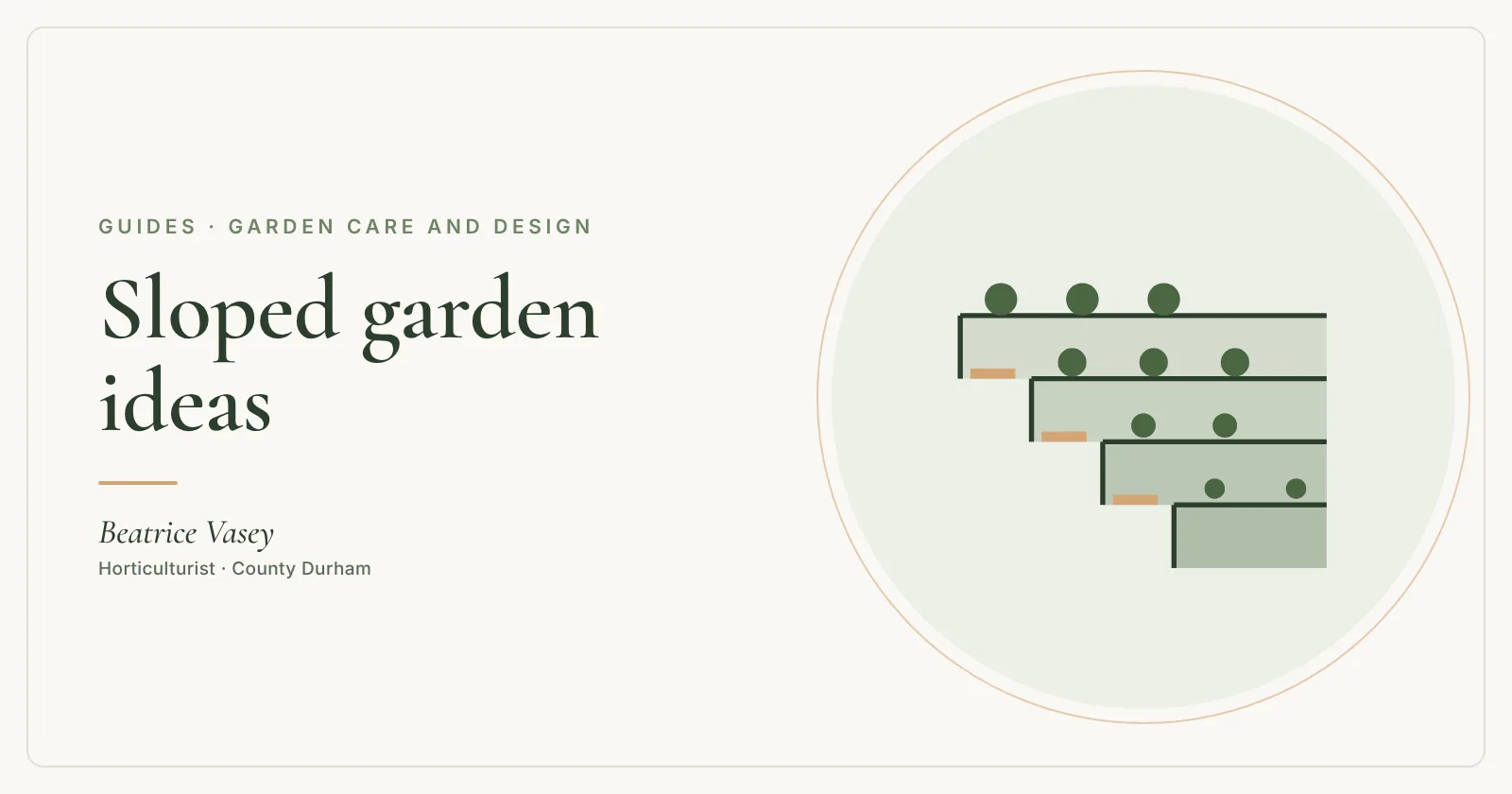
A sloping garden can feel like a problem: water runs downhill, mowing a steep bank is awkward, and nothing sits level. It is also the garden with the most potential for drama. Levels give you views, places to sit that feel separate from the house, and beds you can see properly. The best sloped garden ideas start with the slope you actually have, then decide where you need flat ground and where planting can do the work.
Start by reading your slope
Before choosing terraces, sleepers or plants, spend some time looking at the garden slope itself, the way a garden designer would on a first visit to a sloping site. Five things shape every decision that follows.
| Which way it falls | A garden that slopes up away from the house fills the view from the windows and pushes rainwater towards the house. A downward sloping garden gives you a view out over it, and the low end may be wet. |
|---|---|
| How steep it is | A gentle incline can often take a lawn, a sloping border and a path. A garden that rises steeply usually needs level changes built in, with steps and some form of retaining structure. |
| Aspect | South- and west-facing slopes are warm and sunny and drain quickly; east- and north-facing slopes are cooler and shadier. This decides the planting more than anything else. |
| Where the cold collects | On clear, still nights cold air flows downhill and collects at the lowest point or against a barrier across the slope, such as a hedge or fence. That spot is a frost pocket. |
| Where the water goes | Watch the garden in heavy rain. Note where water runs, where it pools and which parts stay wet for days afterwards. |
Level it, terrace it, or work with the natural slope?
There are three broad ways to landscape a sloping garden, and most good designs mix them. Flattening the whole garden into one level is rarely necessary and is the most disruptive option, because it means moving a lot of soil and holding back what is left.
| Approach | Suits | What it involves |
|---|---|---|
| Work with the slope | Gentle inclines, or banks you only need to look at | Planting the bank, a path that crosses it at an easy angle, perhaps a bench at the top. Little or no hard landscaping. |
| Partial terracing | Most sloping gardens | One or two flat areas where you need them, such as a seating area or a lawn, with the rest of the slope planted. |
| Full terracing | Steep gardens where you want to use the whole space | A series of level terraces held by retaining walls, linked by steps. The most usable result, and the most construction work. |
Terraced garden ideas and retaining walls
A terraced garden breaks the slope into a series of flat steps, each held up by a retaining wall. Terraces reduce the gradient, give you level ground for a patio, lawn or raised beds, and slow down the water that would otherwise run straight off the slope. Each level can have its own job: a seating area by the house, a lawn in the middle, a vegetable plot or wildflower bank further away.
Materials for retaining walls
| Material | Character | Things to know |
|---|---|---|
| Timber sleepers | Warm, informal, quick to build in straight runs | Railway sleepers suit low walls and raised beds. Ask your landscaper how long the timber they use is expected to last in contact with wet soil. |
| Dry stone | Traditional, with gaps that can be planted | Built without mortar, it lets water through and suits plants that like sharp drainage in the crevices. |
| Brick or concrete blocks | Crisp and formal, good for a modern sloping garden | Needs proper foundations and a way for water to escape from behind the wall. |
| Gabions | Wire cages filled with stone, contemporary and free-draining | Heavy and bulky, so they need space and good access to fill. |
When a retaining wall needs an engineer, or permission
I'm a horticulturist, not a builder, and this is the part of a sloping garden design where you need professionals. A retaining wall has to be strong enough to resist the sideways pressure of the soil behind it, and wall thickness is critical. Local Authority Building Control advises that retaining walls should be designed by a competent structural engineer, and that groundwater behind the wall needs an outlet, such as a gravel-filled trench and pipes through the wall.
| Planning permission | In England, permitted development allows a wall up to 2 m high, or up to 1 m next to a road used by vehicles. Above that, or in the grounds of a listed building, you need planning permission. Height is measured from ground level, which is less simple when the ground is higher on one side, so ask your council's planning team before you start. |
|---|---|
| Walls near a street | Under the Highways Act 1980, a retaining wall within 4 yards (about 3.7 m) of a street that is more than 4 feet 6 inches (about 1.37 m) above the street at the boundary has to be built to plans approved by the local authority. |
| Building regulations | Garden walls that aren't part of a house or extension are unlikely to be controlled by building regulations, unless they support the foundations of another building. |
| Raised decks | Decking or a raised platform more than 30 cm above the ground needs planning permission in England, so a deck that hovers over a slope often does. |
Steps, ramps and paths that follow the contours
A straight flight of steps up the middle of a slope is the shortest route, but rarely the most pleasant. Paths that run across the slope, following the contours, are gentler to walk, and a path that zigzags up a steep garden lets you see the planting from different angles as you climb. Wide, shallow stone steps or timber ones feel generous and safe; steep, narrow ones feel like a fire escape.
Building regulations don't cover garden steps, but the guidance for paths up to the front door of new homes is a useful benchmark for comfortable steps and ramps.
| Feature | Approved Document M guidance for approaches to new homes |
|---|---|
| Step height (rise) | 75 mm to 150 mm, with every step in a flight the same |
| Step depth (going) | At least 280 mm |
| Between landings | No flight rising more than 1.8 m without a landing |
| Handrails | A handrail on one side of any flight with three or more risers |
| Ramps | Gradients up to 1:15 for flights up to 10 m long; up to 1:12 for flights up to 5 m |
| Width | At least 900 mm |
If anyone in the household uses a wheelchair, pushes a buggy or wants to wheel a barrow to the top, plan a ramped or gently sloping route from the start. Ramps take up far more length than steps, so plan steps and pathways together: a path that crosses the slope often works better than one that climbs straight up it.
Planting on a slope
This is where a sloping garden can really shine, and where a lot of money spent on hard landscaping can be saved. A bank covered in the right plants holds its soil, needs little care once established, and is far easier to look after than grass you have to mow at an angle. The RHS points out that close-mown grass is usually neither realistic nor safe on steep banks; long grass or a wildflower meadow mix is a good alternative in a less formal garden.
How to plant a bank so it stays put
- Clear perennial weeds first, and work in well-rotted manure or garden compost where you can.
- On steeper slopes, peg down coarse coconut (coir) matting and plant through it. As it rots, stem-rooting plants root into the soil and hold it together.
- Set each plant on its own small, level shelf of soil so that water soaks in around the roots instead of running straight downhill.
- Water each plant in thoroughly, and keep checking through the first growing season.
- Mulch with organic matter such as homemade compost, spread when the soil is already moist, to hold in water and keep weeds down.
- Plant ground-covering shrubs 90 cm to 1.2 m apart, closer on poor soil. In good conditions they should knit together after two growing seasons.
The plants that hold a slope best are ground-covering and spreading shrubs and perennials, which protect the soil surface from rain and wind, and plants with spreading root systems that bind the top layer of soil. A slope drains sharply and exposed ground dries out fast, so right plant, right place matters even more than on the flat.
Plants for slopes in sun and shade
| Conditions | Plants to try |
|---|---|
| Sunny, south- or west-facing slope, sharp drainage | Ceanothus 'Blue Mound', Cistus × purpureus, Genista lydia, Agastache 'Blue Fortune', Thymus pulegioides 'Aureus' as a golden carpet |
| Part shade or north-facing slope | Mahonia aquifolium 'Apollo', Berberis darwinii 'Compacta', Aucuba japonica 'Crotonifolia', Bergenia 'Eroica', Ajuga reptans 'Catlin's Giant' |
| Tough ground cover for large banks | Euonymus fortunei 'Dart's Blanket', Hypericum calycinum, Vinca minor, Rubus 'Betty Ashburner', Euphorbia amygdaloides var. robbiae, Jasminum nudiflorum |
| Crevices and the foot of a sunny wall | Thymes and other small plants that like sharp drainage, tucked into dry stone walls or the gravel at their base |
Check final height and spread against your space, and remember that some bank plants the RHS lists, such as heathers, only grow on acid soil. Spring bulbs that naturalise, such as crocus, snowdrops and many narcissus, are an easy way to add colour to a grassy bank.
More sloping garden ideas: seating, water and rock gardens
Once the levels and planting are settled, a slope gives you features that are hard to create on flat ground. These ideas for sloping gardens all use the change in level rather than fighting it.
| Idea | Why it works on a slope | Keep in mind |
|---|---|---|
| A seating area on the upper level | Looking down over the garden from a small flat area at the top gives the best view in the whole outdoor space. | A paved terrace needs a retaining edge on the downhill side; a gravel area is simpler and lets rain through. |
| Low seating built into a terrace wall | A wall at sitting height doubles as a bench, so a seating area needs no extra garden furniture. | Only on a low wall; the structure still needs building properly. |
| A water feature or rill | Water already wants to run downhill, so a stepped rill or a pond at the bottom follows the land. | The lowest point is also where runoff and cold air collect, so plant around a pond with things that like damp ground. |
| A rock garden or gravel bank | A sunny, free-draining hillside garden suits alpines, thymes and drought-tolerant plants among stone. | Needs full sun and sharp drainage; on wet clay it struggles. |
| Shallow steps with planted edges | A gentle flight of steps edged with low-maintenance ground cover softens the hard landscaping and adds visual interest. | Leave the treads clear; plants spilling over steps make them slippery. |
| A pergola over a path | A pergola across the slope frames the view and gives climbers somewhere to grow. | Posts on a slope need setting firmly; a landscaper can advise on footings. |
On a small sloping garden or a tight budget, the cheapest way to stabilise a bank is almost always planting rather than excavation and walls. You can add one level terrace now and leave the rest of the slope planted, then build more later.
Drainage and clay soil on a sloping garden
Water always ends up at the bottom of a slope. On free-draining soil that may not matter, but much of County Durham is covered by glacial boulder clay, and Durham County Council's landscape guidance describes the soils over most of the county as heavy and poorly drained. On a sloping clay garden, that usually means a dry, fast-draining top and a wet, cold bottom where water and cold air both collect.
| Keep off wet clay | Clay loses its structure if it is dug or walked on when wet, so time groundwork for drier spells. Heavy groundwork on wet clay leaves it puddled and compacted. |
|---|---|
| Raise and mound | Raised beds on a terrace improve drainage, and planting trees and shrubs on low mounds, about 25 cm high, helps them avoid waterlogging. |
| Add organic matter | Bulky organic matter improves clay over time; adding grit or sand takes huge volumes and is seldom worth it. |
| Let water out | Every retaining wall needs a way for water to escape from behind it. Installing land drainage is a major undertaking, so get advice before digging trenches. |
| Plant the wet bit | Garden drainage on a slope is partly a planting job too. Rather than fight a damp foot of slope, plant it with things that like it, such as Iris sibirica, meadowsweet or dogwoods. |
If you want a longer list of plants for heavy clay and wet ground, the same right-plant, right-place principle applies: match the plant to the conditions at each level of the slope, rather than using one planting scheme from top to bottom.
Planning and designing a sloped garden
A slope is the one garden where it really pays to have a plan before anyone starts digging, because the levels, walls, steps and drainage all have to be decided together, and changing them later is expensive. I offer garden design advice for a sloped plot that starts with how you want to use each level and what will grow there, then sets out the layout of terraces, paths and beds around that.
- Decide what needs to be flat. Usually that is a seating area, perhaps a lawn for children, and paths. Everything else can stay sloping and be planted.
- Put the seating where the sun and the view are. On a slope, the top terrace often has the best of both.
- Keep major landscaping to a minimum. Each retaining wall adds cost and needs an engineer's input if it is more than a low step. Planting a bank is far cheaper than walling it.
- Build in stages if you need to. With a plan for the whole garden, each stage fits the next.
I design the garden and the planting; I don't build retaining walls or move earth. For the construction, you can take the design to a landscaper of your choice, or I can introduce you to a vetted landscaper who covers your area (I'm paid a referral fee by that business). Either way, any retaining wall of real height should be designed by a structural engineer.