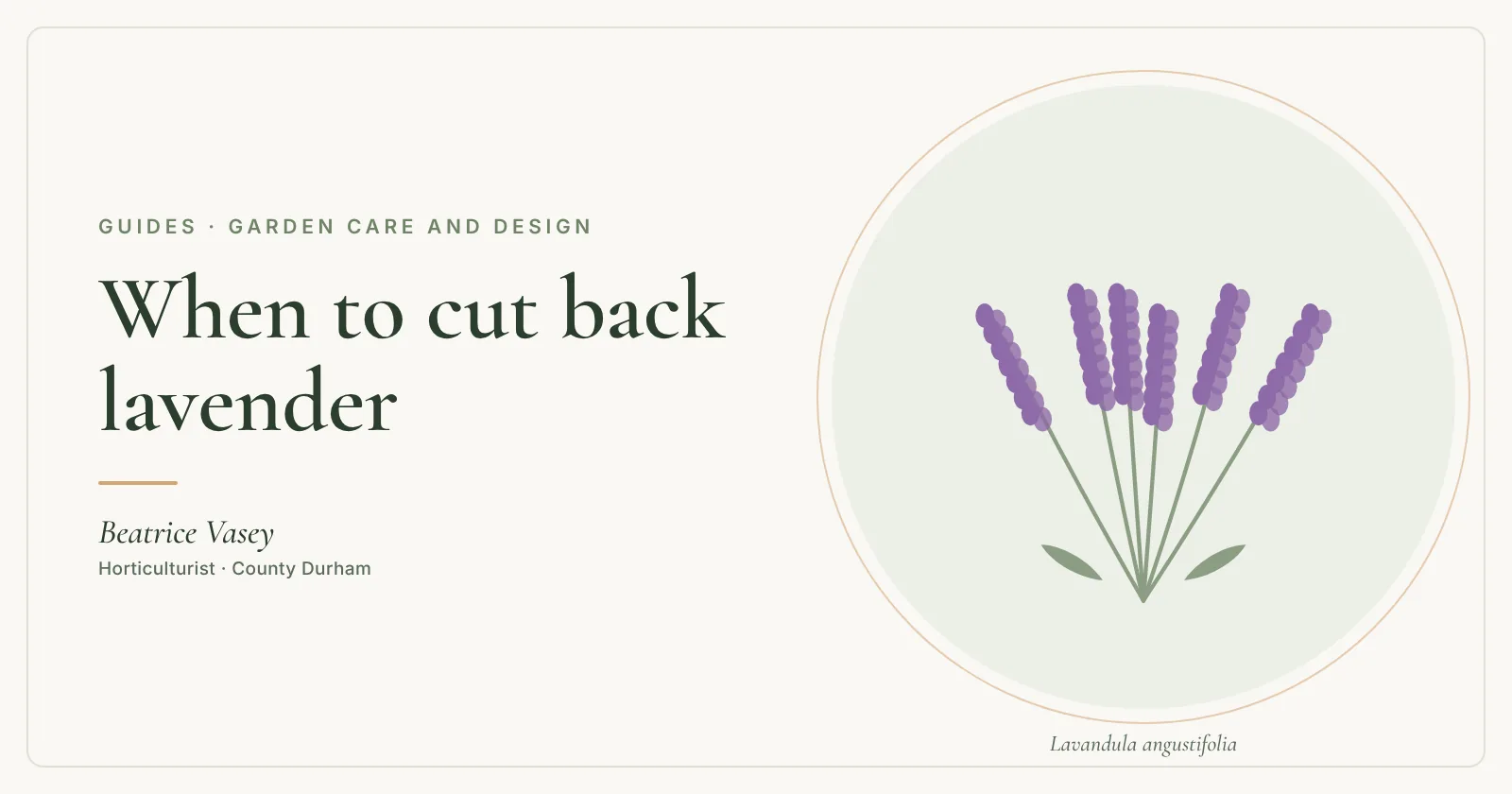
Lavender is one of the easiest shrubs to grow and one of the easiest to spoil with the secateurs. Prune lavender at the right time and it stays a neat, scented mound that blooms year after year. Leave it, or cut too deep, and it turns into a sprawl of bare, woody stems that won't grow back. The good news is that the timing is simple once you know which type you have.
The short answer: when to cut back lavender
The best time to prune lavender in the UK is late summer, straight after the plant has finished flowering. That usually means August for English lavender. The RHS advises trimming every year at this point: remove the flower stalks and about 2.5cm (1in) of the leafy growth below them. Lavender flowers on new growth, so this yearly trim also improves flowering, and doing it now rather than later avoids the autumn pruning the RHS warns against in cold, wet gardens.
Spring is for a light tidy only. If the plant looks untidy or has frost-damaged tips after winter, you can clip over the foliage in mid-spring, once the risk of frost has passed. Spring is not the time for a hard cut.
Whatever the season, the one rule that never changes is this: don't cut into the old, bare wood. Lavender does not reliably regrow from old stems.
When to prune lavender: timing by type
The three main lavender varieties you'll find for sale in the UK all sit in the same RHS pruning group, and all of them should be trimmed after flowering and kept off the old wood. What differs is when they flower and their winter hardiness, and that changes your timing and how cautious to be.
| Type | RHS hardiness | Flowers | Main cut | Spring |
|---|---|---|---|---|
| English lavender (Lavandula angustifolia), e.g. 'Hidcote', 'Munstead' | H5: hardy through most of the UK, even in severe winters | From early summer | Late summer, as soon as flowering finishes (usually August) | Light clip only, if untidy or frost-damaged |
| Lavandin (Lavandula × intermedia), e.g. 'Grosso' | H5 | Slightly later than English lavender | Late summer, once the later flowers fade, so often a little after your English plants | Light clip only |
| French and Spanish lavender (Lavandula stoechas) | H4: hardy through most of the UK, but less tough than English types and often short-lived | A long season through spring and summer | Deadhead as flowers fade, with a light trim in late summer | Tidy frost damage once the cold has passed; never hard prune |
For every type, the RHS plant pages give the same warning: avoid pruning in autumn in wet or cold regions, because it can leave plants vulnerable to winter damage.
How to prune lavender: step by step
You need a sharp pair of secateurs for a few plants, or hand shears for a lavender hedge. Clean blades make cleaner cuts.
- Wait until most of the flowers have faded. On English lavender the spikes fade and dry. There's no need to rush while bees are still visiting.
- Find the green. Part the stems and look at where the soft, leafy growth meets the brown, woody base. That boundary is your limit.
- Remove the flower stalks. Cut every spent flower spike right down to the leaves.
- Trim the foliage. Take off roughly 2.5cm (1in) of the leafy growth, shaping the plant into a rounded dome as you go.
- Check you've left green on every stem. Each stem should still have leaves and new shoots below the cut. If you can see bare wood at the cut, you've gone too far on that stem.
- Leave it alone. Established plants in the ground rarely need watering or feeding after a trim. Lavender prefers poor, free-draining soil.
Regular pruning is what keeps a lavender plant compact and in healthy growth. Left to its own devices, the RHS says, lavender becomes woody and ungainly.
How hard to cut back lavender: stop at the green
The biggest risk when you cut back your lavender is cutting into the woody part of the plant. Lavender does not break new growth easily from old stems, so a branch cut back to bare wood often just stays bare. Cut a whole plant back that way and you can kill the plant.
That's why the annual trim matters more than any single cut. A little each year keeps the green growth low on the plant, so you always have leafy stems to cut back to. Miss a few years and the stems turn woody and leggy, with leaves only at the tips and nothing safe to cut to.
Can you cut back lavender in autumn?
If your plants flowered late, trim them as soon as the flowers fade, in late summer if you can. A cut later in autumn is best avoided, especially in a cold, wet garden. The RHS advice on English lavender, lavandin and French lavender all says the same thing: avoid pruning in autumn in wet or cold regions, as it may leave plants vulnerable to winter damage.
If you missed the summer trim, leave the lavender bush as it is over winter. The old flower heads do no harm, and the RHS notes that leaving them towards the end of the season gives seed-eating birds such as goldfinches something to feed on.
Spring tidy: wait for the last frost in colder areas
The RHS says lavender foliage can be clipped over in spring if growth is untidy or frost-damaged. Its general advice for evergreen shrubs is to prune just before growth starts in mid-spring, after any risk of frost has passed, which avoids frost damage to the new shoots.
So when to cut back lavender in spring depends on where you live. Check the last frost date for your area and do the clip once that has passed, just as new growth is starting. Keep it light: snip off frost-browned tips and any stray stems, and leave the main shaping for after flowering.
In the North East that date varies a lot over a short distance. The North East frost dates on this site, worked out from Met Office records for 1991 to 2020, put the typical last frost at around 25 March in Hartlepool and 29 March in Sunderland, about 16 April in Peterlee, and around 2 May in Durham City. In inland and higher places such as Barnard Castle it is later still. In a cold spring, a late April or May tidy is often safer than a March one.
French and Spanish lavender: deadhead and keep them sheltered
French lavender (Lavandula stoechas, which the RHS also lists under the common name Spanish lavender) has chunky flower heads topped with a tuft of upright bracts. It flowers over a long season in spring and summer, so the main job is deadheading: snip off each faded head down to the leaves through the flowering season. The RHS says deadheading encourages more blooms. Give it a light trim in late summer and, as with English lavender, avoid cutting back into old wood.
It is less hardy than English lavender and tends to be short-lived. The RHS rates it H4 and lists it for sheltered spots, and its growing guide suggests French and other tender lavenders are best grown in containers. In a pot, keep the compost fairly dry over winter and move it to a sheltered place, such as against a house wall or into a cold frame. Some other lavenders, such as Lavandula dentata, are rated only H3, hardy in coastal and relatively mild parts of the UK, so check the label before you plant out.
Pruning young lavender plants in their first year
If you're planting new lavender, the RHS recommends April or May, never in winter, when young plants are prone to rotting in cold, wet soil. Water regularly through the first summer, especially in dry spells.
The RHS doesn't set separate rules for how to prune a young lavender, so give it the same late-summer trim as established ones, just more gently: once the first flowers fade, take off the flower stalks and a little of the leafy tips. On a young plant every stem is still green and leafy, so this is the easiest trim you'll ever do, and it sets up the compact growth you want for the years ahead. Starting early is how you stop a plant from becoming woody later.
What to do with woody, leggy lavender
If your lavender has a bare, woody base, splayed stems and leaves only at the tips, there's no reliable way to rejuvenate it. Cutting back into the woody stems is more likely to finish it off than renew it. The RHS is frank about this: even when pruned every year, older lavender can become straggly, very woody and mis-shapen, and it is best replaced if you want a neat display. Its evergreen pruning guide notes that lavender is generally short-lived and needs replacing after 10 years or so.
Before you dig it out, you can take cuttings. The RHS suggests softwood or semi-ripe cuttings in early to midsummer, and semi-ripe cuttings can still be taken in August. Lavender is fast-growing and establishes quickly, so a new plant will soon fill the gap.
If you'd rather keep a leggy plant a little longer, tidy it lightly after flowering and only trim the leafy tips. Just don't expect it to grow back from the bare wood.
Wet winters and heavy clay: why lavender fails in the North East
Lavender loves sun and well-drained soil, and that's where the purple flowers and scent are at their best. In a County Durham garden, wet soil is often a bigger threat than cold. English lavender and lavandin are rated hardy to between -10°C and -15°C, but the RHS says lavender will not thrive in heavy clay or any soil that becomes waterlogged over winter, and that wet, heavy soil can cause root rots that lead to its early death.
Much of County Durham sits on clay that stays wet in winter. If that's your garden, the RHS suggests planting lavender on a mound or ridge 20 to 30cm (8in to 1ft) high, in a raised bed, or in a pot with large drainage holes and up to a quarter coarse grit mixed into the compost. Or choose plants that cope with heavy clay for that border and keep lavender for the driest, sunniest spot you have.
Pruning can't fix a drainage problem. A lavender that is browning and collapsing from the base on cold, wet ground needs moving or replacing, not cutting back.
Lavender pruning checklist
| Late summer | Main trim straight after flowering: flower stalks off, plus about 2.5cm of leafy growth. |
|---|---|
| Autumn | Avoid pruning in a cold or wet garden. Leave late flower heads for the birds. |
| Winter | Leave it alone. Keep potted lavender fairly dry and sheltered. |
| Spring | Light clip of untidy or frost-damaged tips once the last frost has passed. |
| Always | Leave green on every stem and never cut into the old wood. |
| Every 10 years or so | Replace woody, mis-shapen plants, ideally from your own cuttings. |